Inter Bayamón experiment lifts off today for the Space Station, measuring sound in asteroid dust
CoquíList · With information from El Vocero
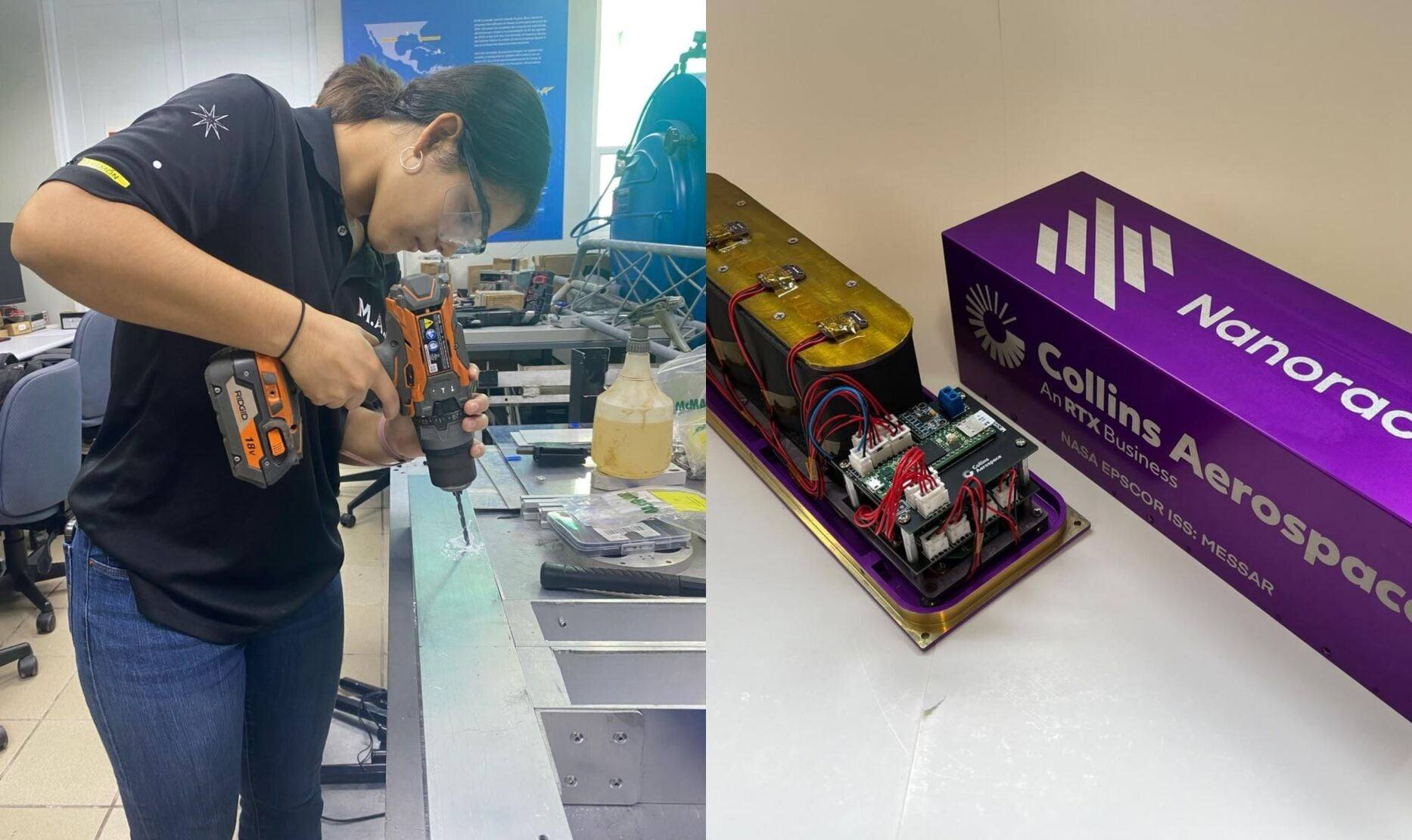
An instrument designed and built in Puerto Rico travels this Sunday, November 29, to the International Space Station (ISS). It is called MESSAR, it was born at the Bayamón Campus of Inter American University (Inter), and it seeks to answer a question that sounds like a movie plot but has real applications: what happens to sound when it passes through rock particles where there is almost no gravity 12.
Liftoff is set for 11:47 a.m. Puerto Rico time from Cape Canaveral Space Force Station in Florida. If it is delayed, the backup window is Monday, November 30, at 11:24 a.m. 1. The experiment rides on Northrop Grumman's Cygnus XL cargo ship, launched on a SpaceX Falcon 9 rocket, on the NG-25 commercial resupply mission 13.
Background: from a Puerto Rican satellite to an orbital lab
The story began in 2021, after PR-CuNaR2, the first Puerto Rican satellite to reach space, which Dr. Amílcar Rincón Charris also developed with Inter students 1. Rincón Charris is an honorary professor of Engineering at Bayamón and an engineer at Collins Aerospace Puerto Rico 1.
The project was presented publicly in October 2025 at Engine 4, the Bayamón technology center, when a January trip to the ISS was expected 4. That date slipped. Now the NG-25 mission is the one carrying it to space 1.
Key facts
- Full name: MESSAR, short for Microgravity Experiment for the Speed of Sound in Asteroid Regolith 1.
- What it measures: how sound travels through fragmented material that mimics an asteroid surface. It does not measure sound in space, but transmission inside a sample 12.
- Team: one professor, six graduates and two Engineering students. The graduates are Sebastián Medina Maysonet, Edwardivan Labarca, Lucas Soto Balseiro, Karelia Silvestrini, Jamie Vázquez and Carlos García. The students are siblings Alejandro and Karina Rincón Torres, the researcher's children 12.
- Installation: if all goes as planned, the instrument will be installed on the ISS on Friday, December 4 1.
- Duration: about six months of tests, with results compared to experiments done on Earth 12.
- Autonomy: the device runs on its own, records acoustic signals and stores data without continuous help from astronauts. The team receives the information by telemetry, and there is a backup memory card 14.
- Institutional backing: the NASA Puerto Rico Space Grant and the Puerto Rico NASA EPSCoR program, with development work at the Engine 4 labs and collaboration from Collins Aerospace and Voyager Space 1.
- Ship's stay: the Cygnus will remain at the station until May 2027, according to NASA 3.
Why it matters beyond the headline
Rincón Charris explains that knowing how sound travels through regolith, the loose dust covering asteroids, is of particular interest for planetary defense 1. The findings could feed mathematical and computer models of the composition and physical behavior of these bodies, useful if one day an object threatening Earth had to be deflected 24.
For Inter, the message is about local talent. The institution's interim president, Jacqueline Álvarez Peña, said Puerto Rico has the talent and capacity to generate scientific knowledge 1. It is also an unusual case: graduates and undergraduates with an experiment operating in an orbital laboratory.
What it means for you
If you are a high school or college student, MESSAR is concrete proof that an engineering or science career on the Island can connect with NASA programs. Part of the support came from federal programs that operate in Puerto Rico, such as Space Grant and EPSCoR 1. If you are a parent, it is an example of a possible path: a project that started as student work and ended up on a rocket.
For the general public, the result will not change your wallet tomorrow. But planetary defense research is the kind that, if it works, protects everyone.
How to / Checklist
- Watch the launch today: liftoff is set for 11:47 a.m. (Puerto Rico time). NASA broadcasts its resupply missions on its site, nasa.gov 13.
- Keep the backup date in mind: if weather or a technical problem intervenes, the next attempt would be Monday, November 30, at 11:24 a.m. 1.
- Mark Friday, December 4: that is the projected date for installing MESSAR on the ISS 1.
- If you want to study engineering or science: ask the admissions office or the Engineering department at your university about research opportunities with Puerto Rico's Space Grant and EPSCoR, which backed this project 1.
- If you are a teacher: use the case as a physics and math lesson. The experiment compares measurements in microgravity with tests on Earth 12.
What's next
After launch, the next milestone is installation on the station on December 4, if the mission keeps its schedule 1. Then come about six months of data collection, to be compared with terrestrial lab results 12. The Cygnus will remain docked until May 2027, so the end of the experiment would fall in that period 3. A delay for weather or technical reasons would shift all those dates.
Sources
CoquiList summary and local context. Read the linked sources for the original reporting.
Ask about this story
Ask anything about this article — in English or Spanish.
Log in to ask about this story.
Comments (0)
Log in to join the conversation.
No comments yet — be the first.